Showing posts with label Mary as our Mother. Show all posts

Thursday, August 22, 2019

“Everywhere Is Love!”: Day 8 in the Preparation for Total Consecration According to St. Maximilian Kolbe


On Day 8, this last day of preparation for our consecration, let us contemplate further St. Maximilian's insight and wisdom regarding the Immaculata - who guided him at each moment of his life - up until he obtained the crown of martyrdom he had chosen as a young boy.
 
"Just a few hours before his second and final arrest, St. Maximilian Kolbe on February 17, 1941, wrote down his last reflections on the Immaculate Conception. The question, "Who are you, O Immaculate Conception?" occupied his priestly mind and heart forming him to be a living witness of the power of the Immaculate and to die as a living offering of love.

[These are his last reflections in their entirety:]

 “IMMACULATE CONCEPTION. These words fell from the lips of the Immaculata herself. Hence, they must tell us in the most precise and essential manner who she really is.
Since human words are incapable of expressing divine realities, it follows that these words: “Immaculate,” and “Conception” must be understood in a much more profound, much more beautiful and sublime meaning than usual: a meaning beyond that which human reason at its most penetrating, commonly gives to them.
St. Paul wrote, quoting the Prophet Isaiah: “Things that the eye has not seen, that the ear has not heard, that the heart of man has not imagined” (Is. 64,4), such are the good things that God has prepared for those who love him (I Cor. 2,9). Here, these words apply fully.
However, we can and should reverently inquire into the mystery of the Immaculata and try to express it with words provided by our intelligence using its own proper powers.
Who then are you, O Immaculate conception?
Not God, of course, because he has no beginning. Not an angel, created directly out of nothing. Not Adam, formed out of the dust of the earth (Gen. 2,7). Not Eve, molded from Adam’s rib (Gen. 2,21). Not the Incarnate Word, who exists before all ages, and of whom we should use the word “conceived” rather than “conception”. Humans do not exist before their conception, so we might call them created “conceptions.” But you, O Mary, are different from all other children of Eve. They are conceptions stained by original sin; whereas you are the unique, Immaculate Conception.
Everything which exists, outside of God himself, since it is from God and depends on him in every way, bears within itself some semblance to its Creator; there is nothing in any creature which does not betray this resemblance, because every created thing is an effect of the Primal cause.
It is true that the words we use to speak of created realities express the divine perfections only in a halting, limited and analogical manner. They are only a more or less distant echo- as are the created realities that they signify- of the properties of God himself.
Would not “conception” be an exception to this rule? No; there is never any such exception.
The Father begets the Son; the Spirit proceeds from Father and Son. These few words sum up the mystery of life of the Most Blessed Trinity and of all the perfections in creatures which are nothing else but echoes, a hymn of praise, a many-hued tableau, of this primary and most wondrous of all mysteries.
We must perforce use our customary vocabulary, since it is all we have; but we must never forget that our vocabulary is very inadequate.
Who is the Father? What is his personal life like? It consists in begetting, eternally; because he begets his Son from the beginning, and forever.
Who is the son? He is the Begotten-One because from the beginning and for all eternity he is begotten by the Father.
And who is the Holy Spirit? The flowering of the love of the Father and the Son. If the fruit of created love is a created conception, then the fruit of divine Love, that prototype of all created love, is necessarily a divine “conception.” The Holy Spirit is, therefore, the “uncreated, eternal conception,” the prototype of all the conceptions that multiply life throughout the whole universe.
The Father begets; the Son is begotten; the Spirit is the “conception” that springs from their love; there we have the intimate life of the three Persons by which they can be distinguished one from another. But they are united in the oneness of their Nature, of their divine existence.
The spirit is, then this thrice holy “conception,” this infinitely holy, Immaculate Conception.
Everywhere in this world we notice action, and the reaction which is equal but contrary to it; departure and return; going away and coming back; separation and reunion. The separation always looks foreword to union, which is creative. All this is simply an image of the Blessed Trinity in the activity of creatures. Union means love, creative love. Divine activity, outside the Trinity itself, follows the same pattern. First, God creates the universe; that is something like a separation. Creatures, by following the natural law implanted in them by God, reach their perfection, become like him, and go back to him. Intelligent creatures love him in the conscious manner; through this love they unite themselves more and more closely with him, and so find their way back to him. The creature most completely filled with this love, filled with God himself, was the Immaculata, who never contracted the slightest stain of sin, who never departed in the least from God’s will. United to the Holy Spirit as his spouse, she is one with God in an incomparably more perfect way than can be predicated of any other creature.
What sort of union is this? It is above all an interior union, a union of her essence with the “essence” of the Holy Spirit. The Holy Spirit dwells in her, lives in her. This was true from the first instant of her existence. It was always true; it will always be true.
In what does this life of the Spirit in Mary consist? He himself is uncreated Love in her; the Love of the Father and of the Son, the Love by which God loves himself, the very love of the Most Holy Trinity. He is a fruitful Love, a “Conception.” Among creatures made in God’s image the union brought about by married love is the most intimate of all (cf. Mt. 19,6). In a much more precise, more interior, more essential manner, the Holy Spirit lives in the soul of the Immaculata, in the depths of her very being. He makes her fruitful, from the very first instant of her existence, all during her life, and for all eternity.
This eternal “Immaculate Conception” (which is the Holy Spirit) produces in an immaculate manner divine life itself in the womb (or depths) of Mary’s soul, making her the Immaculate Conception, the human Immaculate Conception. And the virginal womb of Mary’s body is kept sacred for him; there he conceives in time- because everything that is material occurs in time- the human life of the man-God.
And so the return to God (which is love), that is to say the equal and contrary reaction, follows a different path from that found in creation. The path of creation goes from the Father through the Son by the Holy Spirit; this return trail goes from the Spirit through the Son back to the Father; in other words, by the Spirit the Son becomes incarnate in the Womb of the Immaculata; and through this Son love returns to the Father.
And she (the Immaculata), grafted into the Love of the Blessed Trinity, becomes from the first moment of her existence and forever thereafter the “complement of the Blessed Trinity”.
In the Holy Spirit’s union with Mary we observe more than the love of two beings; in one there is all the love of the Blessed Trinity; in the other, all of creation’s love. So it is that in this union heaven and earth are joined; all of heaven with all the earth, the totality of eternal love with the totality of created love. It is truly the summit of love.
At Lourdes, the Immaculata did not say of herself that she had been conceived immaculately, but, as St. Bernadette repeated, “Que soy era immaculada councepciou”: “I am the Immaculate Conception.”
If among human beings the wife takes the name of her husband because she belongs to him, is one with him, becomes equal to him and is, with him, the source of new life, with how much greater reason should the name of the Holy Spirit, who is the divine Immaculate Conception, be used as the name of her in whom he lives as uncreated Love, the principle of life in the whole supernatural order of grace?”
(Sketch: Feb. 17, 1941")https://www.piercedhearts.org/hearts_jesus_mary/heart_mary/max_kolbe_immaculate_conception.htm

O, how great are the depths of these mysteries and how we must give ourselves time to ponder them - for the above wisdom is the fruit of St. Maximilian's lifelong contemplation of Mary within the plan of the Holy Trinity.
To help us, let's read further of the exuberant joy that comes from contemplating the greatness of God's love and His plan of salvation:
 
With Mary on a Mission
“Everywhere Is Love!” 
“Scrutinizing with ecstatic admiration the divine plan of salvation, whose origin is the Father who freely willed to communicate to creatures the divine life of Jesus Christ revealed wondrously in Mary Immaculate, Father Kolbe, fascinated and enraptured, exclaims: ‘Everywhere is love’ (KW1291). 
The gratuitous love of God is the answer to all doubts.‘God is love,’ says St. John (1Jn 4:8)”. These words, pronounced by Pope St. John Paul II during his homily of December 8,1982, at Santa Maria Maggiore, two months after the canonization of Father Kolbe, hold the key to understanding mission in the perspective embraced and lived by St. Maximilian. 
Mission, in fact, it is all about love: the “excessive” love of God the Father who dreams of the happiness of every creature and gives His Son for us (cf.Jn 3:16). It is about the “excessive” love of Christ, who became man for us in Mary's womb, let His Heart be pierced on the Cross to quench our dry and hard hearts with the living Water of His Spirit, with His Body broken and his Blood poured forth for us (Jn 19:17-37). It is about the humble love of the young woman of Nazareth, who offered her womb and heart to God in the abandonment of faith, so that in time and in history He could realize this plan of salvation and love (cf.Lk 1:26 -38).
With the depth of the mystics and saints, Maximilian, follower of St. Francis, understood that the infinite love of the Triune God for humanity was fully revealed through Jesus Christ. In the mystery of the Incarnation and the Cross, God humbled Himself, became poverty, weakness, flesh. The Lord Jesus stripped / emptied Himself of everything and surrendered to our hands (cf. Phil 2:6-7):  
He is totally-given Love...
St. Maximilian, however, did not forget that the mystery of this “emptying” took place in the womb of Mary, as St. Paul reminds us: “When the set time had fully come, God sent his Son, born of a woman, born under the law”(Gal 4:4). For a special gift of grace, we could say for a unique “charism,” Maximilian was allowed to grasp and accept with great clarity the mystery and mission of Mary in God's plan. 
For Maximilian, Mary is not only the creature whom God chose as His Mother to enter into the world: she is the Immaculata, the new Woman, the redeemed humanity dreamed of by God. She is, even today, the Mother of God who became man, called to continue to work with the Holy Spirit in generating the Son in the hearts of men. (emphasis mine)

“... And the Word was made flesh (Jn 1:14) as the result of the love of God and the Immaculata. So He became the firstborn, the Man-God, and souls are not reborn in Christ by any other way, other than through the love of God toward the Immaculata and in the Immaculata.” (KW1296)
http://missionimmaculata.com/images/Documents/preparation_for_consecration/Preparation_for_MI_Consecration_Part_6.pdf
 
Wow! 
Just as Jesus became incarnate through Mary and the power of the Holy Spirit, so Christ is made incarnate again in each of us through the same eternal exchange of love of the Holy Spirit and the Immaculata! 
It is a great mystery, which at its heart can be summed up:
"Everywhere is love!" 
All life, all existence, all grace is the excessive unbounding love of God, which the Immaculata alone receives and incarnates perfectly - not only in and for herself - but in all those who unite themselves perfectly - (fully) to her! 
(I pray this summation of these great mysteries does justice to them...)
St. Maximilian further explains in practical ways how Mary's love perfects our offerings:
"... It is true that we love the Father in the Son, in Jesus Christ, and to Him we must give all our love, in order that in Him and through Him all our love might be received by the Father. But it is not any less true that our acts, be they even as holy as possible, are not without blemish, and if we want to offer them to Our Lord pure and immaculate, we must direct them straight to Her who alone is Immaculate, and give them to Her as Her property, so that as Her own property She might give them to Her Son. Then they will become without blemish, immaculate. Having then received an infinite value through the Divinity of Jesus they will worthily honor God." https://saintmaximiliankolbe.com/the-essence-of-marian-devotion/

Lastly, here is one last quote which, again, in practical terms expresses what complete abandonment to the will of God through Mary looks like in our lives:
From the Writings of St. Maximilian Kolbe (KW 46 and 56)
Let us work with prudence, patience, and humility, but with perseverance, purifying continuously our intentions, to fulfill only the will of God through the Immaculata, helping each other by prayer, advice and action.
Let us be led, let us be quiet, quiet, let us not claim to do more than she wants, or faster [than she wants it]. Let her carry us; she will take care of everything, she will provide for all our needs of the soul and the body; let us give to her any difficulty, displeasure, let us trust that she will take care of them better than we could. Therefore peace, peace, a lot of peace in unlimited confidence in her. We did not make the MI; we do not know nor can carry it forward. If the MI belongs to our Heavenly Mother, the obstacles will make it stronger, and if not, let it fall; why should we meddle? If even our Heavenly Mother would not want the MI to last, but be content with what it has done so far, she is Our Lady; may she do whatever she likes. Let us take care of things, but let us not worry about them. We need that the external and internal tribulations, the failures, the listlessness, the fatigue, the jeers, the misfortunes, and other crosses purify and strengthen us. It takes a lot of patience even with ourselves and even with the good God, who tries us out of love."

This abandonment of everything into the hands of Mary is another way of expressing our abandonment of everything to God and His Holy Will;
for it is His Will that we give ourselves completely to Mary so she and the Holy Spirit can form us into other Christs...
When and if we do so, 
we come to trust ever more fully that all is love, which is another way of saying with all trust that "all things work together for good for those who love God" (Romans 8:28)

When we understand this, we can be filled with true joy and peace    
even when all our plans fail, 
even when we are ridiculed, rejected, tested and tried...
even when we are called to give up our life - 
in a thousand tiny ways throughout each day or ultimately in martyrdom -
for we truly understand that it is in dying we are born to eternal life!
It was this abandonment to God, through Mary the Immaculata, which enabled Maximilian to be filled with the grace and peace and love of God in the midst of a "struggle [that] is not with flesh and blood but with the principalities, with the powers, with the world rulers of this present darkness, with the evil spirits in the heavens" (Eph 6:12).

It can do the same for us. 
If we also give all we are to Mary (for the love of God), their love will form us, too, into living offerings of love and witnesses of the power of the Immaculata.

St. Maximilian, be with us and help us to live this total consecration through prayer, mortification and Charity in the midst of this great battle for our souls and the souls of all God's children.
Intercede for us to become great saints in and through the Immaculata, our advocate - as we attend Mass, pray the mysteries of the rosary and wear the miraculous medal - not only in preparation for our Total Consecration, but from now on daily (to the extent that it's possible), praying:

O Mary, conceived without sin, pray for us who have recourse to you, and for all those who do not have recourse to you, especially the enemies of Holy Church and all those recommended to you.
 

© Janet Moore 2019. All Rights Reserved.
 

Wednesday, August 21, 2019

Holiness Amid Evil: Day 7 in the Preparation for Total Consecration According to St. Maximilian Kolbe

St. Maximilian Mary Kolbe wrote about the saints and sanctity quite often. His first rule of life was  
“I must become a saint, and a great saint.” ...
As we might expect, St. Maximilian tells us that to become holy is our duty to God. It is not an option..."
https://saintmaximiliankolbe.com/saints-and-sanctity-part-1/
In an article he wrote in "The Knight of the Immaculata" in 1922, he likened sainthood to secular success - noting that being successful, whether in the world or for heaven, is similar in many ways. For both secular genius and sanctity require:
extraordinary single-heartedness, 
undeterred focus on achieving seemingly impossible goals regardless of the obstacles or setbacks - even when opposed by both those closest to them (those in whom one expects to be supportive) as well as enemies.
Both saints and the great achievers are often seen as different from most people, and they attract attention and/or disdain as they steadfastly pursue their dream - never quitting despite many failures - until, eventually, their success becomes a source of inspiration for those who aspire to be like them.
However alike their outward characteristics are, their inner dispositions and motivations are very dissimilar: 
one is concerned about earthly greatness, while the other is concerned about heavenly glory; 
the secular man often seeks this glory at the expense of what is most important - such as love and family; while the saint incorporates Divine Love into all that he thinks, says and does;
the worldly man achieves only momentary happiness or it's counterfeit, while the saint 
"achieves the greatest happiness possible in this life and perfect happiness in the next. For the great man of the world, the Cross is a burden to be dragged or thrown off in disgust. For the saint, the Cross is the easy yoke and light burden of Sweet Jesus who desires to give us rest (cf. Mt 11:30). The beatitudes, that is, the blessings of God by which we become happy, are summarized by the words: Blessed are they that suffer persecution for justice’s sake, for theirs is the kingdom of heaven (Mt 5:10). St. Maximilian called this “suffering willed out of love.” It is the destiny of the saint: perfect holiness and happiness. The secular man, no matter how great, cannot understand this. For the saint, no matter what life brings, good or ill, the opportunity to serve God is always present."https://saintmaximiliankolbe.com/saints-and-sanctity-part-1/
It was this single-hearted devotion to the Will of God and the love of the Immaculata that would be a source of life for Maximilian in the death camp, never forgetting that he was engaged in a battle for souls:
"In 1924, St. Maximilian Kolbe wrote an article entitled “Our Tactics” for his magazine. ...His premise was that even though in the spiritual life we are not engaged in a conflict with flesh and blood, waging war with guns and ammunition, we are still fighting a real war. Success in this conflict requires that we have a battle plan.
The spiritual life is a battle because the eternal destiny of our souls hangs in the balance. God wants us to go to heaven and the devil wants us to go to hell. The battle is over our hearts, to which we alone hold the key. Everything hangs on the choice that we make, and the determination at the end of our lives is absolute, final and irrevocable. We are either totally victorious or totally destroyed.
St. Maximilian’s simple formula for victory in this fight is prayer, mortification and charity. ... Prayer, of course, is more important than anything else because while, on the one hand, the Holy Spirit tells us “without Me you can do nothing,” on the other, He says “all things are possible with God” (Jn 15:5; Lk 1:37). Our destiny then, is wholly beyond our natural strength, but nonetheless, God desires to empower us to attain what is above and beyond us. That is the definition of supernatural: “above and beyond nature.” So grace is the fuel for the engines of our war. It is the life of our soul and can only be obtained through recognition of our need and by an attitude of humility. Prayer gains everything 
and nothing is gained without it.
Of course, St. Maximilian would remind us that the most effective prayer is that which is offered through the hands of the Immaculate. She is our conduit to heaven. She is our Advocate who brings our prayers to heaven, and our Mediatrix who dispenses God’s grace to us. The second requisite, mortification, is necessary because in order for us to live forever, that is, in order for us to survive the battle and be crowned victors, our old self must die. Our Lord says: “He who saves his life will lose it, but he who loses his life for my sake will find it” (Mt 10:39, 16:25; Mk 8:35; Lk 9:24, 17:33; Jn 12:25). The paradox of the Christian life is that in order to live we must die, like Christ. In the end, we all pass through the veil of death into eternity, but while we live, we must choose to die.
St. Bonaventure says: “‘My soul rather chooseth hanging and my bones death.’ He who chooses this death can see God because this is indubitably true: ‘Man shall not see me and live’ ” (Itinerarium Mentis in Deum, 7:6, quoting Job 7:15 and Ex 33:20). Thus, mortification is our daily, even hourly choice to impose death on all that is offensive to God, and even on that which is not convenient to our eternal salvation, such as inordinately seeking the attention of others and talking too much.
In particular, St. Maximilian reminds us, contrary to the Protestant understanding of justification, that our mortification, done in cooperation with God’s grace, in fact wins for us an increase of grace. Grace is always first, but we must cooperate and our cooperation is efficacious.
Finally, charity, the third requisite in this battle plan, is a necessary tactic because salvation and victory over our enemy is a matter of God’s everlasting love for us. If it is true that we are only saved by grace, and that God hears our prayers and gives us what we need, then it is for us a lesson in the fundamental importance of charity. It tells us that we, too, must have the generosity and selflessness of Christ. In fact, we are all united in Him as members of the same family and, ultimately, our victory is a triumph over that isolation which is pride and selfishness. Satan desires to bring about our destruction through the debilitating plague of inordinate self-love: charity foils his plan.
Furthermore, grace has truly united us as members of the same family and we can never be severed from the communion of Saints, except by sin. “No man is saved alone,” as the saying goes. Either we are a cohesive army, or we are a defeated army.
Prayer, mortification and charity: a simple strategy, but an unbeatable one. Not even the Prince of this World can withstand it. In union with Our Queen, and under Her banner, we are assured of victory if only we follow Her instructions and commands. https://saintmaximiliankolbe.com/st-maximilians-tactics-for-total-victory/

These marks of Prayer, Mortification and Charity that imbued Maximilian's life in and through Mary, would carry him through the terrible battle against evil that faced him in Auschwitz:  
"On February 17, 1941, Father Maximilian was arrested by the Nazis for a second time. Only hours before the Gestapo arrived, he completed his final and most comprehensive, theological essay on the Virgin Mary’s identity as one who is perfectly united to the Holy Spirit by a bond of love. Soon after, in the concentration camp, Father Maximilian would translate his theological and spiritual insights into practical words and actions for his fellow inmates, by tangibly showing that there is God, and therefore, love and hope exist even in the midst of horrific genocide in the camps of Auschwitz.
Only a saint can stand firm, with constancy and unwavering hope, throughout life’s many difficulties and sufferings.  Only a saint can influence others to do the same, because only a saint knows that true and perfect peace is found in God alone. For the saint, trials don’t weaken, they fortify. Serenity and calmness amidst atrocities are not a sign of defeat but of victory, for love is greater than hatred!" https://saintmaximiliankolbe.com/biography/

"After a brief internment in a notorious Polish prison, Kolbe was sent to Auschwitz concentration camp and branded prisoner #16670". While there, he was sent to the work camp, which involved carrying blocks of heavy stone used to build the crematorium wall. The work camp was overseen by a brutal, vicious man: the ‘Bloody Krott’ who singled out Maximilian for particularly cruel treatment. On one occasion Krott forced Maximilian to "carry the heaviest planks until he collapsed; he then beat Kolbe savagely, leaving him for dead in the mud. But fellow prisoners secretly moved him to the camp prison, where he was able to recover." Prisoners reported that Kolbe faced appalling mistreatment with "calm ... deep faith and dignity", as he "remained selfless and often shared his meager rations with others". 
On June 15, he was able to send a letter to his mother.
“Dear Mama, At the end of the month of May I was transferred to the camp of Auschwitz. Everything is well in my regard. Be tranquil about me and about my health, because the good God is everywhere and provides for everything with love. It would be well that you do not write to me until you will have received other news from me, because I do not know how long I will stay here. Cordial greetings and kisses, affectionately. Raymond.” https://www.biographyonline.net/spiritual/maximilian-kolbe.html
"In the harshness of the slaughterhouse Father Kolbe maintained the gentleness of Christ. At night he seldom would lie down to rest. He moved from bunk to bunk, saying: 'I am a Catholic priest. Can I do anything for you?'
A prisoner later recalled how he and several others often crawled across the floor at night to be near the bed of Father Kolbe, to make their confessions and ask for consolation. Father Kolbe pleaded with his fellow prisoners to forgive their persecutors and to overcome evil with good. When he was beaten by the guards, he never cried out. Instead, he prayed for his tormentors.
A Protestant doctor who treated the patients in Block 12 later recalled how Father Kolbe waited until all the others had been treated before asking for help. He constantly sacrificed himself for the others."http://www.auschwitz.dk/kolbe.htm


"In July 1941, three prisoners appeared to have escaped from the camp; as a result, the Deputy Commander of Auschwitz ordered 10 men to be chosen to be starved to death in an underground bunker.
When one of the selected men Franciszek Gajowniczek heard he was selected, he cried out “My wife! My children!” At this point, Kolbe volunteered to take his place.
The Nazi commander replied, “What does this Polish pig want?”
Father Kolbe pointed with his hand to the condemned Franciszek Gajowniczek and repeated: “I am a Catholic priest from Poland; I would like to take his place because he has a wife and children.”
Rather surprised, the commander accepted Kolbe in place of Gajowniczek. Gajowniczek later said:

“I could only thank him with my eyes. I was stunned and could hardly grasp what was going on. The immensity of it: I, the condemned, am to live and someone else willingly and voluntarily offers his life for me – a stranger. Is this some dream?
I was put back into my place without having had time to say anything to Maximilian Kolbe. I was saved. And I owe to him the fact that I could tell you all this. The news quickly spread all round the camp. It was the first and the last time that such an incident happened in the whole history of Auschwitz.” https://www.biographyonline.net/spiritual/maximilian-kolbe.html
"A personal testimony about the way Maximilian Kolbe met death is given by Bruno Borgowiec, one of the few Poles who were assigned to render service to the starvation bunker. He told it to his parish priest before he died in 1947:
'The ten condemned to death went through terrible days. From the underground cell in which they were shut up there continually arose the echo of prayers and canticles. The man in-charge of emptying the buckets of urine found them always empty. Thirst drove the prisoners to drink the contents. Since they had grown very weak, prayers were now only whispered. At every inspection, when almost all the others were now lying on the floor, Father Kolbe was seen kneeling or standing in the centre as he looked cheerfully in the face of the SS men.
Father Kolbe never asked for anything and did not complain, rather he encouraged the others, saying that the fugitive might be found and then they would all be freed. One of the SS guards remarked: this priest is really a great man. We have never seen anyone like him ..
Two weeks passed in this way. Meanwhile one after another they died, until only Father Kolbe was left. This the authorities felt was too long. The cell was needed for new victims. So one day they brought in the head of the sick-quarters, a German named Bock, who gave Father Kolbe an injection of carbolic acid in the vein of his left arm. Father Kolbe, with a prayer on his lips, himself gave his arm to the executioner. Unable to watch this I left under the pretext of work to be done. Immediately after the SS men had left I returned to the cell, where I found Father Kolbe leaning in a sitting position against the back wall with his eyes open and his head drooping sideways. His face was calm and radiant ..' http://www.auschwitz.dk/kolbe.htm
Father Maximilian Kolbe was executed on 14 August, 1941 at 12:30. He was forty-seven years old. His body was disposed of in the crematorium,"like hundreds of thousands who had gone before him, and hundreds of thousands more who would follow.
The heroism of Father Kolbe went echoing through Auschwitz. In that desert of hatred he had sown love. A survivor Jozef Stemler later recalled: 

'In the midst of a brutalization of thought, feeling and words such as had never before been known, man indeed became a ravening wolf in his relations with other men. And into this state of affairs came the heroic self-sacrifice of Father Kolbe.' Another survivor Jerzy Bielecki declared that Father Kolbe's death was 'a shock filled with hope, bringing new life and strength ... It was like a powerful shaft of light in the darkness of the camp.'" http://www.auschwitz.dk/kolbe.htm
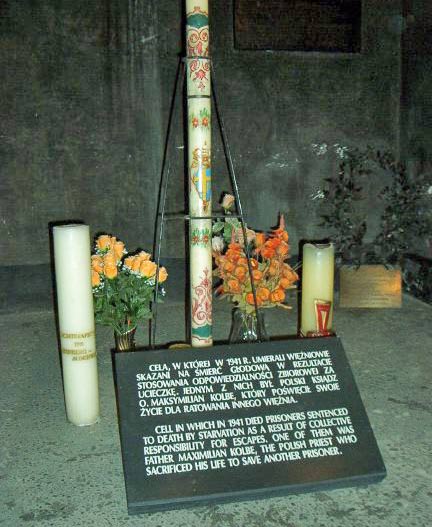
kolbe-cell
Cell here Kolbe was executed

"The cell where Father Kolbe died is now a shrine. 

Maximilian Kolbe was beatified as Confessor by Paul VI in 1970, and canonized as Martyr by Pope John Paul II in 1981" http://www.auschwitz.dk/kolbe.htm, saying: “Maximilian did not die but gave his life … for his brother." 


Franciszek Gajowniczek
"Franciszek Gajowniczek would miraculously survive Auschwitz, and would later be present at Kolbe’s canonisation in 1971.
"He died on March 13, 1995, at Brzeg in Poland, 95 years old - and 53 years after Kolbe had saved him. But he was never to forget the ragged monk. After his release from Auschwitz, Gajowniczek made his way back to his hometown, with the dream of seeing his family again. He found his wife but his two sons had been killed during the war.
Every year on August 14 he went back to Auschwitz. He spent the next five decades paying homage to Father Kolbe, honoring the man who died on his behalf." 

http://www.auschwitz.dk/kolbe.htm
 
From the Writings of St. Maximilian Kolbe (KW 1065)
"Let all also embrace their brothers with charitable hearts, enduring suffering and difficulties for God’s sake. Let them do good to everyone, including their enemies, only for the love of God and not in order to be praised or thanked by men. Then they shall realize what it means to have a foretaste of heaven and find peace and happiness even in poverty, in suffering, in disgrace, in sickness. Such foretaste of paradise is also a sure harbinger of eternal bliss.
Indeed, it is not easy to exert self-control in the manner described above to achieve this happiness, but remember that those who ask it of the Immaculata with humility and perseverance will certainly achieve it, because she is unable to deny us anything, nor is the Lord God able to deny her anything. Anyway, we shall shortly know exactly what it will be like in heaven. Surely in a hundred years none of us will still be walking on this earth. But what are a hundred years in the face of what we have been through?... And who will have to wait as many more years?... Soon, therefore, provided we are well prepared, under the protection of the Immaculata."
Reading and rereading about the greatness of St. Maximilian's holiness amid such evil and darkness is the best way to prepare today... 
May we do so, asking:
St. Maximilian, be with us and help us to pray, to sacrifice ourselves and to choose to always love in this great battle for our souls and the souls of all God's children - even in the midst of evil and darkness.
Intercede for us to become great saints in and through Mary, our great advocate, as we pray today the mysteries of the rosary and wear the miraculous medal in preparation for our Total Consecration, praying:

O Mary, conceived without sin, pray for us who have recourse to you, and for all those who do not have recourse to you, especially the enemies of Holy Church and all those recommended to you.
 

© Janet Moore 2019. All Rights Reserved.

Sunday, August 18, 2019

“Only love creates”: Day 5 in the Preparation for Total Consecration According to St. Maximilian Kolbe

 
We love because God first loved us! John 4:19
In turn, we love in and through the Immaculata - 
(St. Maximilian's favorite name for Mary - 
the one she herself used at Lourdes, saying: "I am the Immaculate Conception")
 - because she, also, first loved us!
“Only at the time of God’s judgment in Heaven shall we become aware of the solicitude that our tender Heavenly Mother has had for each of us, ever since the beginning, of the solicitude that she has toward every soul, her child, to shape it according to the pattern of Jesus, her firstborn Son, the prototype of holiness, God and man” (KW1313).
Pope Benedict XVI said at the inaugural Mass of his pontificate, “Christ does not take anything and gives everything.” As already proclaimed by the Second Vatican Council: “Only Christ fully reveals man to himself. Only in the mystery of the incarnate Word does the mystery of man take on light” (GS22). And this is the motherhood of the Militia of the Immaculata, according to the desire of St. Maximilian, proclaiming Jesus Christ! 
“That is the MI: to let her into all hearts, to bring her into being within all hearts, that by entering those hearts and taking most perfect possession of them, she may there give birth to the  sweet Jesus, God, and there raise Him to perfect age. What a beautiful mission! ... Is that not true? ... The elevation of man to God Man, through Man God’s Mother” (KW508). http://missionimmaculata.com/images/Documents/preparation_for_consecration/Preparation_for_MI_Consecration_Part_5.pdf

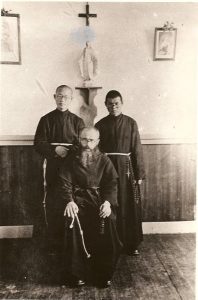
This beautiful mission that St. Maximilian longed to live out and share with all souls developed a step further in 1930... when the City of the Immaculate in Poland had been established for three years ... St. Maximilian and four other friars journeyed to Japan in order to found another "City for Mary."

The Garden of the Immaculate

A saint’s heart can never be constrained to geographical boundaries. He is, by grace, always a missionary. This was especially true of St. Maximilian Kolbe. He loved the Immaculate with the Heart of Jesus, and he loved Jesus with the heart of Mary. It is manifested in a similar, universal desire to win all souls to Jesus and the Immaculate.
St. Maximilian in JapanWith the permission of his superiors, St. Maximilian, considering the need for further expansion, started a mission in Japan with four other friars in 1930. At Nagasaki, they established a new “City of the Immaculate” (Mugenzai no Sono – literally “Garden of the Immaculate”), thereby introducing his ideal, the Immaculate, to the Orient. In spite of problems with local authorities, language, culture, and climate – one month after their arrival, Father Maximilian was, nevertheless, able to publish the first issue of “Seibo no Kishi,” the Japanese version of the magazine “Knight of the Immaculate.”
He wrought numerous conversions among the Japanese; most of them thanked him for his heroic and unconditional sacrifice to draw them to the true Faith. But St. Maximilian recognized that this apostolic success could only be attributed to a pure and undivided love for the Immaculate. Where there is love and charity, there is God. (https://saintmaximiliankolbe.com/biography/)
To announce Jesus Christ is a beautiful mission, because every person finds in Him the happiness and fullness of meaning for his or her life. We may share the spiritual motherhood of Mary, not only listening to the Word of God, but also by becoming co-workers in her maternal mission. In fact Maximilian writes that Mary does not want to carry out her mission alone, but that she wants to engage us too. Motherhood means care, love, attention to others. Maximilian is an effective witness to it. The proclamation of the Gospel is the greatest act of love; it is the first charity. The Gospel message transforms the proud-hearted and gives the humble the awareness of their dignity, as already announced by the Virgin of Nazareth in her Magnificat. The proclamation of the Gospel is also the first form of charity for every member of the Militia of the Immaculata. 
Maximilian Kolbe, facing the reality of his time (atheism in particular) said that: 
“These poor people, therefore, need light, a great deal of supernatural light, of supernatural energy. They are unhappy, discontented, because they take as their ultimate goal what is only a means and therefore, after reaching the happiness to which they aspire, cannot find what they were looking for. And they continue to search with a dejected heart, with bitterness in their souls. How can we fail to reach out to them? How can we not to help them placate their hearts, lift their mind above all that passes toward the one ultimate purpose, God? Love for one’s neighbor pushes those souls who have already found the true ideal of life not to forget their brothers and sisters around them. One of the many associations that practice this love of one’s neighbor is the Militia of the Immaculata” (KW1237). 
Maximilian is also a witness of that love which is ready for martyrdom. Maximilian is the “man for man,” who lived with the conviction that “Only love creates” (cf. KW1205). This is the lesson he learned in his deep and intimate daily experience of communion with Christ through his consecration to the Immaculata. 
Being at the school of Mary led Maximilian, and can lead each of us, to be “for others” in everyday life, in the family, at work, in our social relationships. The Marian manner of life has love as its center, its heart, its fundamental dimension. http://missionimmaculata.com/images/Documents/preparation_for_consecration/Preparation_for_MI_Consecration_Part_5.pdf
From the Writings of St. Maximilian Kolbe (KW 925)
"Mutual love does not consist in the fact that no one ever causes any sorrow in us, but that we strive not to cause grief to others and we become accustomed to forgiving whatever hurts us immediately and completely. In such mutual forbearance lies the essence of mutual love. 
St. Thérèse writes: “I saw only too well how very imperfect was my love for my Sisters; I did not really love them as Jesus loves them. I see now that true charity consists in bearing with the faults of those about us, never being surprised at their weaknesses, but edified at the least sign of virtue. I see above all that charity must not remain hidden in the bottom of our hearts, for ‘no man lighteth a candle and putteth it in a hidden place, nor under a bushel; but upon a candle-stick, that they who come in may see the light’ [Lk 11:33]. It seems to me that this candle is the symbol of charity; it must shine out not only to cheer those we love best, but ALL those who are of the household.” 
 And later she writes: “I know, my Jesus, that You never command the impossible; You know better than I do how frail and imperfect I am. You know perfectly well that I can never hope to love my Sisters as You love them, unless You Yourself love them in me. It is only because You are willing to do this that You have given us a New Commandment, and I love it because it is my assurance that You desire to love in me all those whom You command me to love.” The deeper such love, the more effective will missionary activity be."

The deeper our love, the more effective all our activity will be...
What a profound truth!
May we never forget this 
nor neglect to ask for and be open to more and more love.
For this deeper love that is so effective is nothing less than Divine Love and forgiveness.
Remembering "To Forgive is Divine."
Thus, may this preparation fill us with ever deeper love that forgives all those who have harmed us in order to help create a "Garden of the Immaculata" in our hearts and in our lives.
So that, in and through our Total Consecration to her, 
Mary is able
to love others with her own Motherly heart through us!
- especially those who are the hardest ones for us to love.
 
Let us pray: 
Come Holy Spirit, living in Mary, help us to prepare well for our Total Consecration.
St. Maximilian,
Be with us and help us become the love of Mary and Jesus as we give ourselves entirely and without reserve to both of them in complete surrender. 

So, that Mary, in turn, can draw us ever closer to Jesus and make of us great saints! 
Pray for us and help us live out the love you poured out to win all souls for Christ through Mary and the Miraculous Medal! We ask this in Jesus's Name, Amen.
Lastly, may we never forget to recognize that the prayer Mary taught us and that wearing the miraculous medal are true gifts of heaven. May they help us to be a garden of Mary's and Jesus's love where there is hatred, unforgiveness and hurt, disbelief and discontent:

O Mary, conceived without sin, pray for us who have recourse to you, and for all those who do not have recourse to you, especially the enemies of Holy Church and all those recommended to you.
 

© Janet Moore 2019. All Rights Reserved.